DeTour Township · St. Mary’s River
Stone Mountain Harbor Development Project
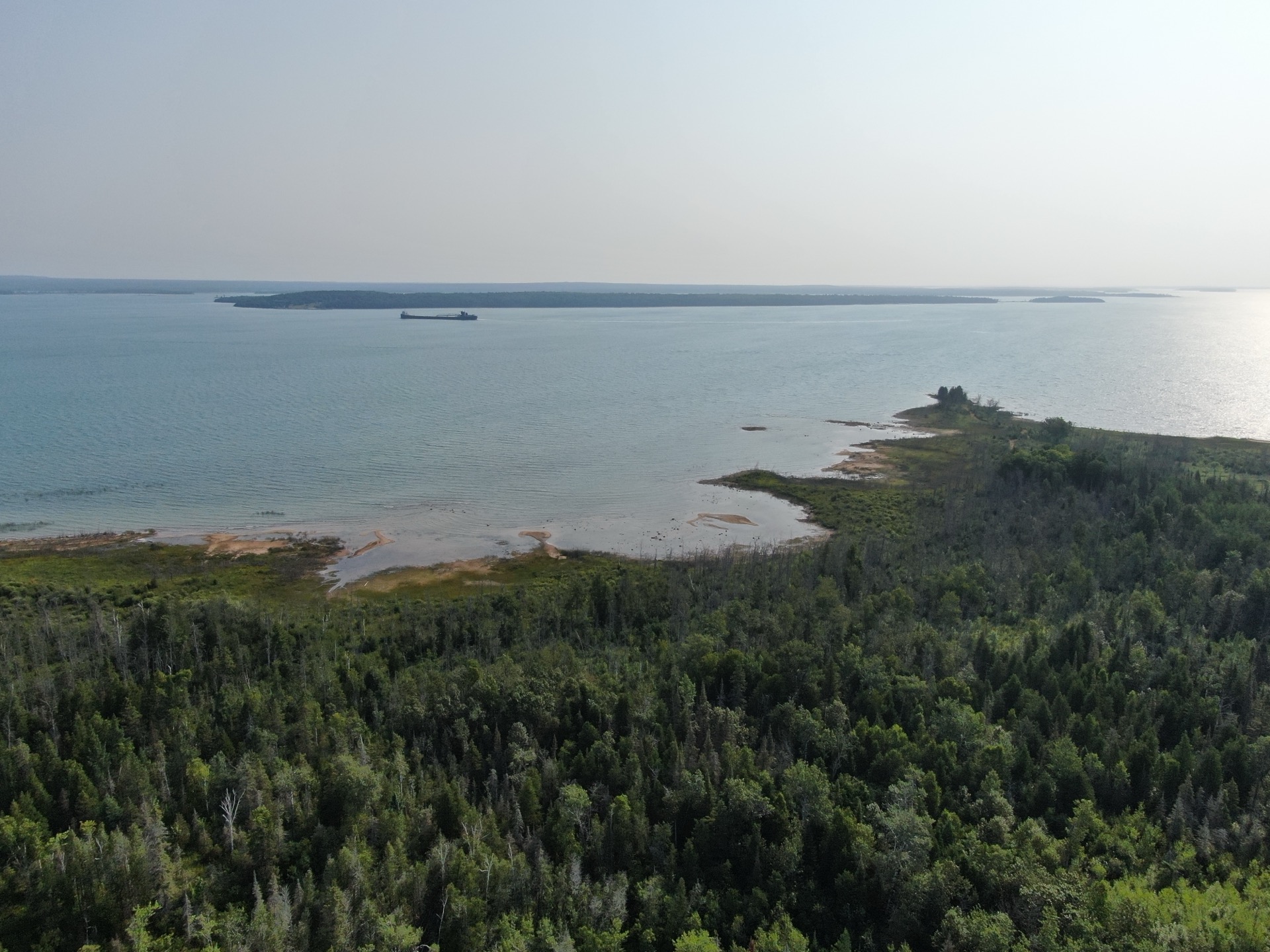
Stone Mountain Harbor is a planned multi-use port facility on a waterfront site along the St. Mary’s River in DeTour Township, Michigan. Located directly adjacent to Stone Mountain Aggregates, the harbor will enable efficient vessel loading of limestone, forestry products, general cargo, and dredged material — connecting an active MSHA-certified quarry to Great Lakes shipping routes.
The Demographic Challenge
DeTour Township and the broader eastern Upper Peninsula face one of the most severe demographic declines in Michigan. The median age in DeTour Township is approaching 67 — among the oldest communities in the state. DeTour Village population fell from 418 in 1990 to 263 in 2024 (a 37% loss). Township population dropped from 894 in 2000 to 679 in 2023. Across the Upper Peninsula, K–12 enrollment has declined nearly 48% since 1970.
Young people leave because there are few good-paying, long-term jobs. Without new economic anchors, classrooms empty, services contract, and the community’s ability to sustain itself erodes. Stone Mountain Harbor is designed to reverse this trajectory by creating the kind of industrial and maritime employment that can retain and attract working-age families.
Jobs and Regional Economic Impact
Construction is expected to generate approximately 120 full-time equivalent jobs over an 18-month period. Once operational, the port is projected to support 40–50 permanent jobs in maritime operations, logistics, and related activities. A community foundation funded by a dedicated contribution on every ton of material moved through the port will provide ongoing support for youth retention, training, and workforce development.
Beyond direct employment, the harbor restores competition in a Great Lakes aggregates market increasingly dominated by foreign-owned companies. It will be the first major American-owned, water-accessible aggregate source added to the system in decades — improving supply security and pricing stability for construction, steel, cement, and agricultural markets across the region.
Capacity and Logistics Advantages
- Annual marine capacity of up to 10 million tons (projected demand from the adjacent quarry alone reaches several million tons per year).
- Over a 30-year analysis period the facility is expected to handle approximately 141.5 million tons of cargo.
- Mode shift from truck to vessel eliminates an estimated 8.8 billion truck ton-miles, reducing highway crashes, diesel consumption, and emissions.
- High-capacity ship loader (approximately 3,500+ tons per hour) designed for faster vessel turnaround than older Great Lakes systems.
- Direct adjacency to the quarry eliminates intermediate trucking between mine and dock.
Strategic Resilience for the Great Lakes System
Nearly all iron ore and a large share of Great Lakes cargo move through the Soo Locks. A U.S. Department of Homeland Security analysis found that a prolonged closure of the Poe Lock would shut down the majority of U.S. integrated steel production and trigger cascading losses measured in millions of jobs and over a trillion dollars in GDP. Stone Mountain Harbor provides additional berthing and transfer capacity on the St. Mary’s River, offering a practical redundancy option while the new lock is completed and for the decades that follow.
Multi-Use Design and Environmental Performance
The port is designed as a greenfield facility, allowing modern standards for stormwater management, shoreline protection, cold ironing, and efficient cargo handling to be built in from the start. Planned uses extend beyond limestone to forestry products (opening markets currently constrained by Mackinac Bridge weight and cost limits), general cargo, and potential dredged-material recycling. The project will fully comply with NEPA, USACE, and EGLE requirements. A net-positive environmental approach is a core design goal, including shoreline conservation measures and habitat opportunities.
Community Partnership
Stone Mountain Harbor is advancing the project in coordination with DeTour Township, regional economic development organizations, and tribal communities of the eastern Upper Peninsula. The structure prioritizes local contracting, shared economic opportunity, and long-term community benefit. Formal partnership details will be made public as agreements are finalized.
Project Status
Active development and permitting
Property is controlled, preliminary engineering is complete, pre-application coordination with USACE and EGLE has occurred, and environmental review is underway. The project is positioned for construction following completion of federal and state permitting.